Integration of HIRADC Based on ISO 45001 and JSA for Risk Mitigation in Gold Jewelry Casting
Keywords:
HIRADC, Job Safety Analysis, ISO 45001:2018, Gold Jewelry Casting, Near Miss, K3Abstract
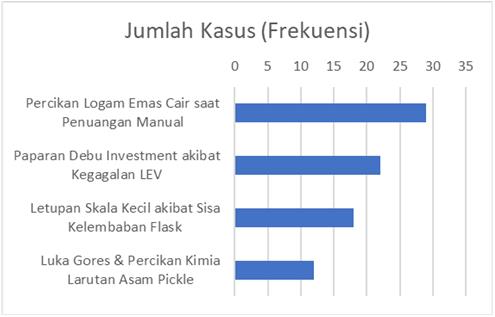
The casting area in the gold jewelry manufacturing industry has a high level of work risk due to exposure to high temperatures, hot materials, and chemicals. Although PT XYZ has implemented an Occupational Health and Safety Management System based on ISO 45001:2018, near-miss incidents continue to occur, necessitating an evaluation of the risk control system that has been applied. This research aims to evaluate the K3 risk management system and formulate control recommendations thru the integration of the Hazard Identification, Risk Assessment, and Determining Control (HIRADC) method and Job Safety Analysis (JSA). The research uses a qualitative descriptive approach with a cross-sectional design. Data were obtained thru observation, in-depth interviews with five senior casting operators and one HSE Officer, as well as documentation studies of 81 near-miss data from the period of January 2024 to May 2026. The results of the HIRADC analysis show that the activities of moving hot cylinders and pouring molten metal have the highest risk levels with the Extreme Risk category (RR = 20), while the processes of calcination, gypsum unloading, and pickling fall into the High Risk category (RR = 12–16). Analysis using JSA shows that the high risk is influenced by unsafe actions, the use of PPE that does not yet match the job characteristics, and the suboptimal condition of the work facilities. Based on these results, control recommendations were formulated, including the improvement of the Local Exhaust Ventilation (LEV) system, the use of anti-fog face shields, the provision of gloves more suitable for precision work, and the refinement of SOPs and Work Instructions. The results of the residual risk assessment indicate that the proposed controls can reduce the risk level of all critical activities to the Low Risk category (RR = 2–4). Thus, the integration of the HIRADC and JSA methods can be used as an effective approach to identify potential hazards and develop more precise risk controls in the gold jewelry casting process.