Quality Control of Woven Textile Products to Identify and Reduce Defects Using the Statistical Process Control (SPC) Method
Keywords:
Statistical Process Control (SPC), Quality Control, Textile Industry, Pareto Diagram, U Control Chart, Product Defects, Sarung WeavingAbstract
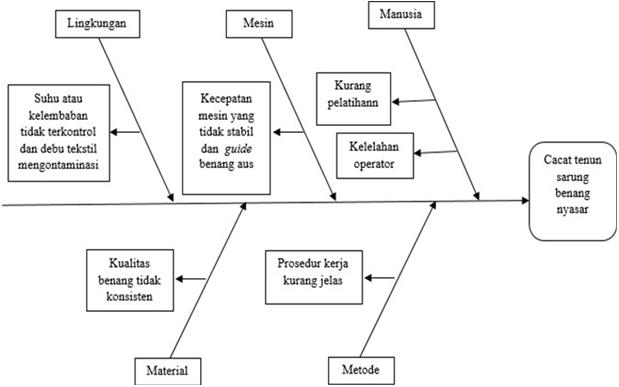
- Putra Mundel is a textile weaving company specializing in sarong fabric production. However, its quality control system has not been optimal, as indicated by frequent product defects. This study aims to identify the largest defect types and propose improvement strategies using the Statistical Process Control (SPC) method. A quantitative approach was applied using Pareto diagrams, U control charts, cause-and-effect diagrams, and data adequacy and uniformity tests. Based on 2024 production data, 53,217 sarong units were produced, with 1,202 defective products recorded over ten months. Pareto analysis showed that stray yarn defects were the most dominant (39%), followed by holes (29%), incorrect size/short length (18%), and unclear motifs (14%). The main contributing factors include inadequate machine maintenance, operator fatigue and lack of accuracy, substandard raw materials, unfavorable environmental conditions such as temperature and humidity, and unclear work procedures. Proposed improvements include scheduled machine maintenance, regular employee training, material inspection upon arrival, environmental monitoring, implementation of work shifts, and the development of clear visual Standard Operating Procedures (SOPs). These strategies are expected to reduce defect rates and improve overall product quality.